A major economic event towards the end of the year brings positive signals for the investment environment in Vietnam. According to information from VnEconomy and VnExpress International, the Government and the electricity sector have implemented measures to adjust key input costs for production and commerce.
Retail electricity price cut for the first time in two decades
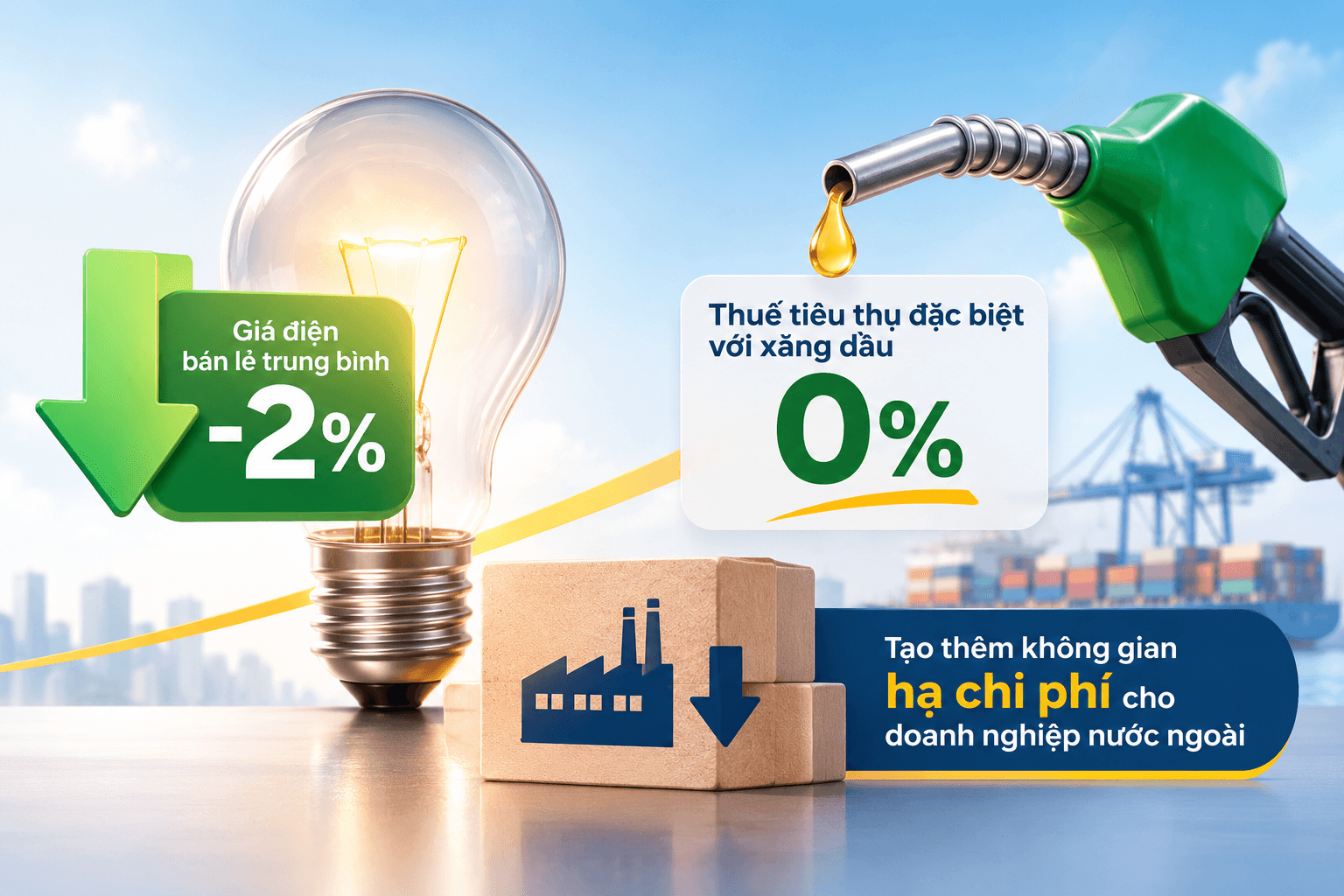
According to Vietnam Electricity (EVN), the average retail electricity price officially decreased by 2% from November 1, 2026, down to over VND 2,159.9 (equivalent to 8.2 US cents) per kWh, excluding Value Added Tax (VAT). As noted by VnExpress International, this is the first time the average electricity price has decreased in nearly 20 years, excluding 5 price and electricity bill reductions aimed at supporting citizens and businesses during the Covid-19 pandemic. This move follows electricity price increases of 18.2% between 2023 and 2025 through 4 adjustments, with the most recent increase implemented in May 2025. According to EVN, the electricity price reduction reflects efforts to optimize operating costs, contributing to macro-economic stability and supporting social security as directed by the Government.
Special consumption tax on fuel reduced to 0%
Alongside electricity prices, the Government also issued a policy to reduce the special consumption tax on all types of gasoline to 0%, effective from November 1, 2026, to March 31, 2027. According to the resolution signed by Deputy Prime Minister Nguyễn Văn Thắng, this tax rate is adjusted in alignment with orientations on environmental protection, value-added tax, and special consumption tax on gasoline, oil, and jet fuel. Previously, under the Law on Special Consumption Tax effective from July 1, 2026, the applicable tax rate was 10% for conventional gasoline, 8% for E5 biofuel, and 7% for E10 biofuel. Bringing the tax rate to 0% accounts for a proportion of about 6.69% in the base price of gasoline, creating room for retail price reductions, thereby lowering transportation, production, and business costs for the market.
Significance for businesses
The combination of lower retail electricity prices and reduced fuel taxes has a direct impact on cutting operating costs for manufacturing plants, logistics units, and foreign commercial enterprises operating in Vietnam. According to Deputy Prime Minister Nguyễn Văn Thắng, these adjustment measures simultaneously provide about 0.07 percentage points of room to control inflation, aiming towards the 4.5% target set by the National Assembly. For the foreign investment business community, easing the pressure from these two critical input costs not only optimizes financial balance sheets but also reinforces confidence in the stability of Vietnam's macroeconomic environment in the short and medium term.
SUNINCON accompanies investors through market research services, industrial park surveys, and factory construction advisory to optimize business strategies in Vietnam.
References
- VnEconomy
- VnExpress International