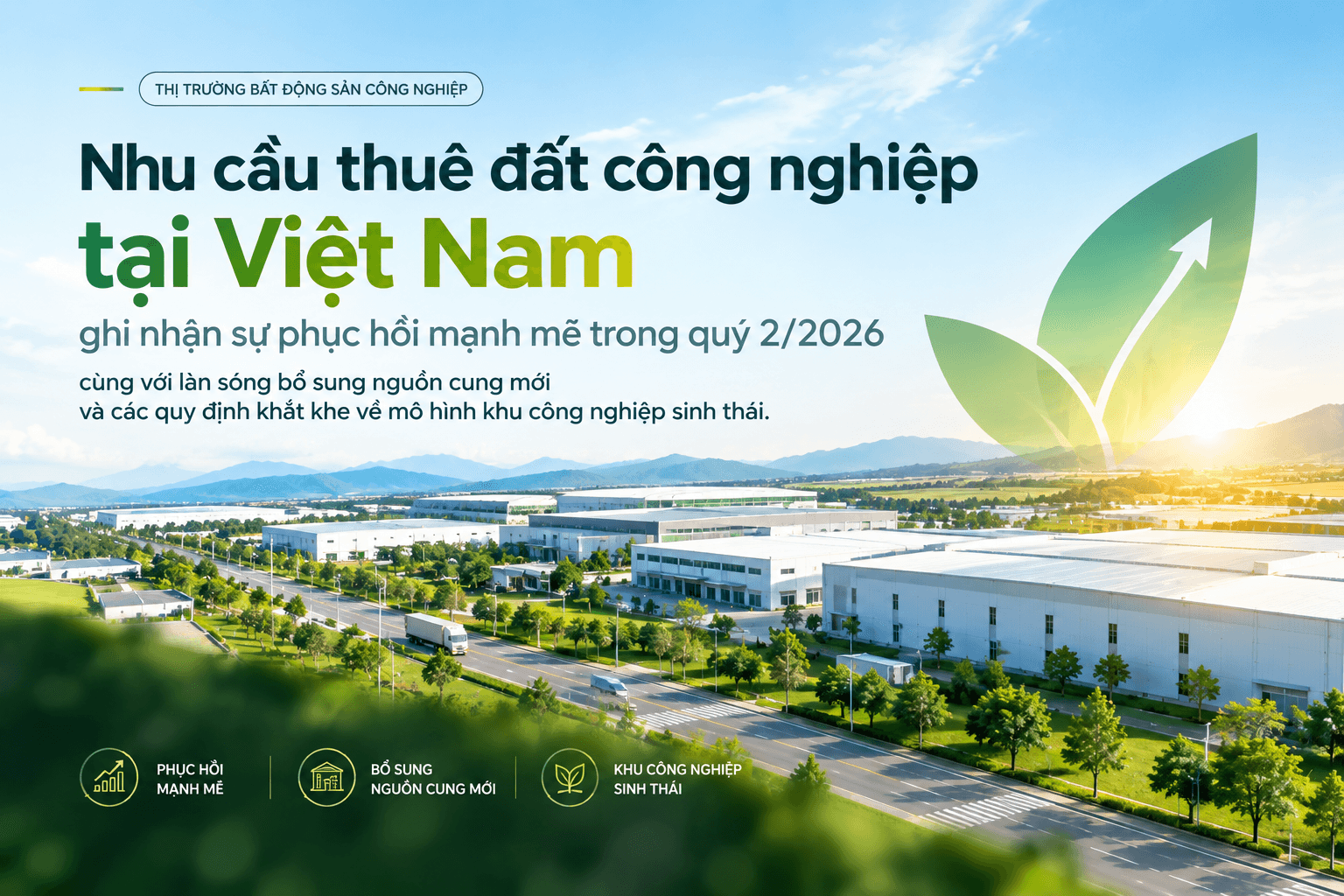
Following a growth slowdown in 2025 caused by tariff uncertainties, Vietnam's industrial real estate market is witnessing a clear rebound in land leasing demand and production expansion. Alongside a fresh wave of industrial land supply across key economic zones, regulatory and technical requirements are evolving rapidly—notably with green transition roadmaps enforcing stricter eco-industrial park standards across major economic hubs.
Rebound in Net Absorption and Rising Rental Trends
According to an SSI Research report, industrial park real estate profits are projected to grow robustly in 2027, driven by stable foreign direct investment (FDI), leasing demand recovery, and expanded land supply. Following a cautious first quarter, net absorption in the Northern region reached approximately 217 ha in Q2 2026, up sharply from 134 ha in Q1 2026 and marking the highest quarterly level since 218 ha in Q1 2024. In the Southern region, net absorption in Q2 2026 also rose to 67 ha, improving markedly from 57 ha in the previous quarter and 10 ha in the same period of 2025.
Surging demand has put upward pressure on rents. CBRE data indicates that average asking rents in the North reached USD 143/m2 per lease cycle in Q2 2026, up 2.9% year-on-year. In the South, asking rents reached USD 185/m2, representing a 3.7% increase. SSI Research forecasts that the total area under new lease contracts and memorandums of understanding (MOUs) for surveyed developers will increase by 18.6% year-on-year in 2027, largely driven by foreign enterprises expanding operations and relocating production to tier-2 industrial zones.
Readied New Supply and Large-Scale Projects
To accommodate manufacturing demand, new industrial land supply is anticipated to accelerate in late 2026 and into 2027, with approximately 1,347 ha entering the market. The Northern region is expected to contribute 664 ha concentrated in Bac Ninh, Thai Nguyen, Hai Phong, and Hung Yen; the Southern region will add 683 ha across Dong Nai, Binh Duong, Long An, Tay Ninh, and Ba Ria – Vung Tau.
In Central Vietnam, the Da Nang City People's Committee issued Decision No. 4602/QD-UBND granting investment policy approval and investor selection for the WHA Industrial Park Da Nang project, implemented by WHA Industrial Development International (SG) Pte. Ltd. Spanning 400 ha across Thang Binh and Dong Duong communes, the project represents a total investment exceeding VND 2.7 trillion (equivalent to USD 105 million), comprising VND 459.24 billion in investor equity (16.95%) and nearly VND 2.25 trillion in mobilized capital (83.05%). The project has a 50-year operational term and will be deployed in two phases (200 ha each) from Q4 2027 to Q1 2034, while being required to designate land reserves for worker housing and public services.
In Ho Chi Minh City, FDI inflows in the first nine months reached USD 17.2 billion, 4.2 times higher than the same period last year. Industrial parks and export processing zones managed by Hepza alone attracted nearly USD 5.7 billion, exceeding the full-year 2026 target by 34%, with FDI capital up 62.27% compared to the same period in 2025. To welcome high-tech investment waves, Hepza is preparing 6,500 to 6,800 ha of clean land reserves for 2025–2030, while digitizing administrative procedures to reduce pre-checks and shift toward post-licensing inspections under the Law on Investment.
Green Standards Redefining Technical Entry Barriers
Beyond land expansion, industrial development is shifting substantially toward environmental quality. According to VnEconomy, Ho Chi Minh City is finalizing a draft resolution setting criteria for eco-industrial parks and industrial clusters, with a roadmap to convert 10 existing industrial parks and 3 industrial clusters to the eco-model by 2045.
Under the draft, these standards establish explicit entry requirements:
- Eco-enterprise criteria: Businesses must demonstrate full legal compliance during the two years prior to registration across seven areas: investment, business operations, construction, land, environmental protection, fire prevention and fighting, and labor.
- Resource efficiency: Existing enterprises must implement at least three solutions covering efficient resource use, cleaner production, or circular economy practices, achieving a minimum 5% reduction in raw materials, water, energy, or chemicals consumption, or at least a 5% cut in waste and emissions. For new investors, the draft requires adopting Best Available Techniques (BAT) from developed nations instead of the 5% threshold.
- Infrastructure planning: Eco-industrial parks must allocate at least 25% of land area for green space, internal transport, and shared technical and social infrastructure (rising to 28% for newly developed parks), including a minimum of 12% for green spaces and 2% for social infrastructure. Furthermore, parks must foster at least three industrial symbiosis initiatives and adopt corresponding ISO management systems.
Strategic Implications for Businesses
Rebounding demand and rising rental costs mean international manufacturers must finalize their site selection strategies swiftly to optimize long-term operational expenses. The allocation of new industrial supply toward tier-2 provinces and key regional hubs like Da Nang offers additional viable alternatives for supply chain diversification.
Meanwhile, the rollout of eco-industrial park frameworks and Best Available Techniques (BAT) requirements in Ho Chi Minh City signals that regulatory compliance thresholds are rising markedly. When planning greenfield projects, foreign investors must look beyond clean land access and incorporate integrated environmental management systems, circular resource models, and industrial symbiosis synergies to ensure compliance with post-clearance oversight by authorities.
To support foreign investors in establishing efficient manufacturing operations in Vietnam, SUNINCON delivers end-to-end solutions ranging from Industrial park surveys and processing Investment licences (IRC/ERC) to Factory construction advisory tailored to current technical and regulatory standards.
References
- VnEconomy – Industrial park real estate profits expected to rise sharply in 2027
- VnEconomy – HCM City proposes stricter criteria for eco-industrial parks
- VnEconomy – Da Nang approves WHA industrial park investor with total capital exceeding VND2.7 trillion
- VnEconomy – HCM City readies clean land, regulatory reforms to absorb hi-tech FDI inflows