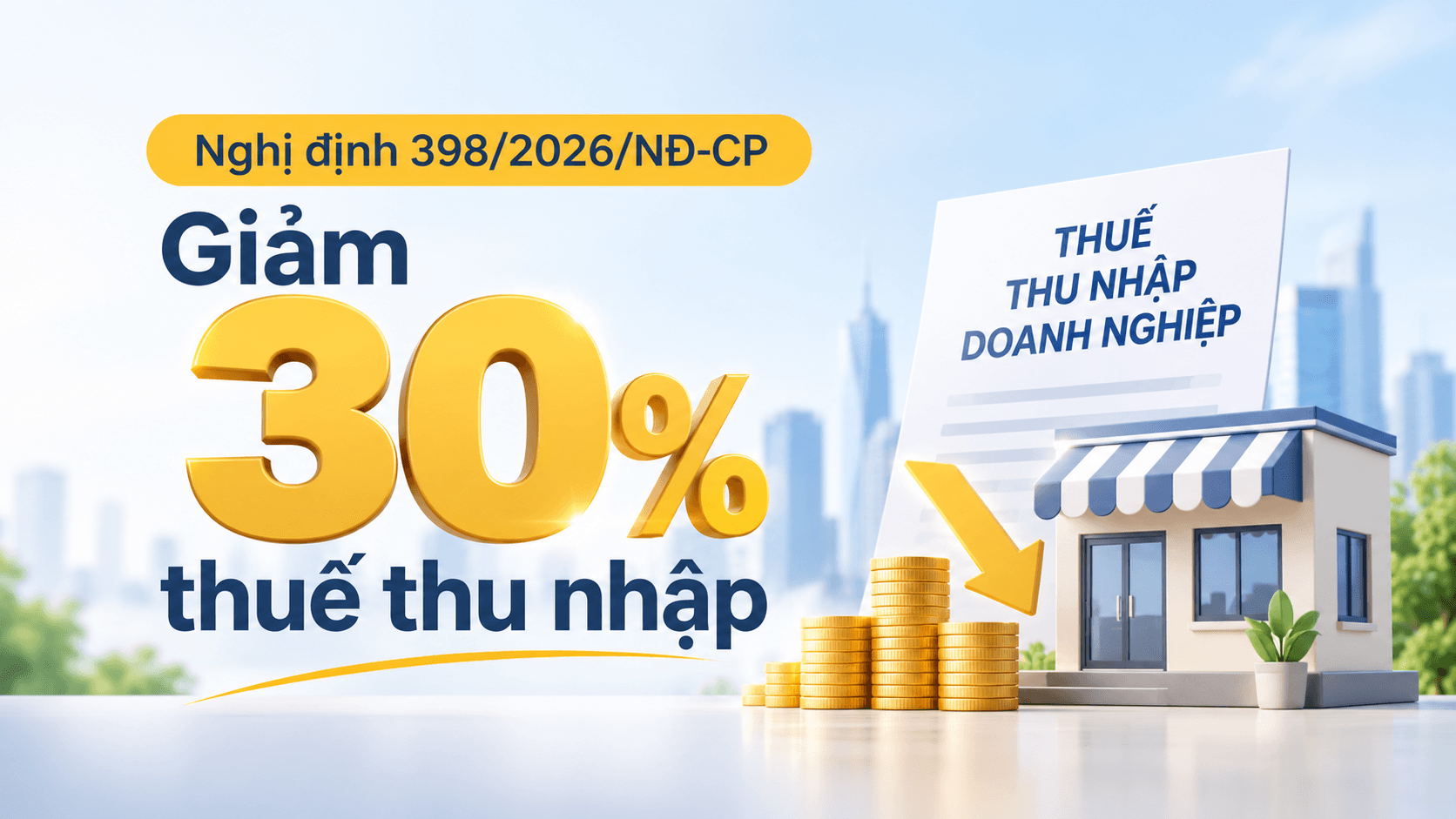
The Government issued Decree 398/2026/ND-CP (Decree 398), effective from 29 October, implementing a 30% income tax reduction for enterprises and household businesses with annual revenue under VND 10 billion (equivalent to over USD 388,000). According to reports from online newspaper VnEconomy, this regulation applies to two consecutive tax periods: 2026 and 2027. The Ministry of Finance estimates that this support will reduce budget revenues by approximately VND 6.7 trillion (over USD 260 million) over the two-year period, with an estimated coverage of about 81.1% of enterprises and 99.86% of individual and household businesses nationwide.
Application Mechanism and Scope of Income Tax Reduction
This reduction policy is designed to apply directly to tax liabilities arising from production and business activities, helping taxpayers retain resources for ongoing operations and reinvestment:
- Tax scope: The incentive applies solely to corporate income tax and personal income tax derived from business activities; it does not apply to value-added tax. The 30% reduction is calculated based on the tax amount payable, not as a 30% deduction from revenue or a direct reduction of nominal tax rates.
- Self-determination and provisional payment mechanism: Enterprises are permitted to self-determine the 30% reduction when making provisional quarterly corporate income tax payments, provided that their estimated annual revenue does not exceed VND 10 billion. For household and individual businesses, the 30% deduction applies to personal income tax payable on monthly, quarterly, or per-occurrence declaration bases.
- Cumulative application on existing incentives: Notably, enterprises already eligible for corporate income tax incentives under prior regulations are still entitled to an additional 30% reduction on the remaining tax payable after applying those existing incentives.
Revenue Determination Rules and Legal Constraints
The core eligibility criterion under Decree 398 is based on actual full-year revenue rather than initial estimates made during provisional filings. According to VnEconomy, enterprises should note strict regulations concerning total revenue calculation methods and threshold excess handling:
- Comprehensive revenue consolidation: Revenue for qualifying purposes includes all sales of goods, provision of services, financial income, and other income arising during the year. Enterprises with dependent branches, affiliates, or directly affiliated business locations must aggregate all revenues from these units.
- Restrictions on divided and split enterprises: Strict restrictions also apply to businesses established via division or demerger after 24 August (the effective date of National Assembly Resolution 43). If the combined total revenue of these newly formed entities exceeds VND 10 billion per year, they will not qualify for the tax cut policy.
- Clawback mechanism upon exceeding threshold: If cumulative actual revenue during the year exceeds the VND 10 billion mark, the taxpayer is disqualified from the incentive and must immediately adjust their tax declaration in the period the threshold was breached, repaying all previously deducted tax amounts. Supplementary payments in this circumstance will not incur late payment penalties prior to the tax filing deadline for that period.
Implications for Businesses
For foreign investors and operating entities in Vietnam, this policy creates several tangible impacts on financial strategy:
First, it directly assists with operational costs for newly formed legal entities, small-scale branches, or early-stage investment projects whose revenues have not exceeded VND 10 billion. An additional 30% income tax reduction alongside existing incentives helps alleviate tax burdens during 2026 and 2027.
Second, extending tax reductions to 81.1% of enterprises and 99.86% of household businesses significantly improves cash flow for local suppliers, subcontractors, and supporting partners. This reinforces stability across the domestic supply chain.
However, enterprises must prioritize cash flow management and closely forecast cumulative revenue quarter by quarter, particularly during year-end peak periods. Breaching the VND 10 billion threshold without reserve budget planning may trigger sudden liquidity pressure when having to reimburse all tax benefits claimed from prior quarters.
SUNINCON is ready to assist investors through our Tax and legal advisory services, support with Company incorporation procedures, and Supply chain network optimization to ensure full compliance with financial regulations in the Vietnamese market.
References
- VnEconomy