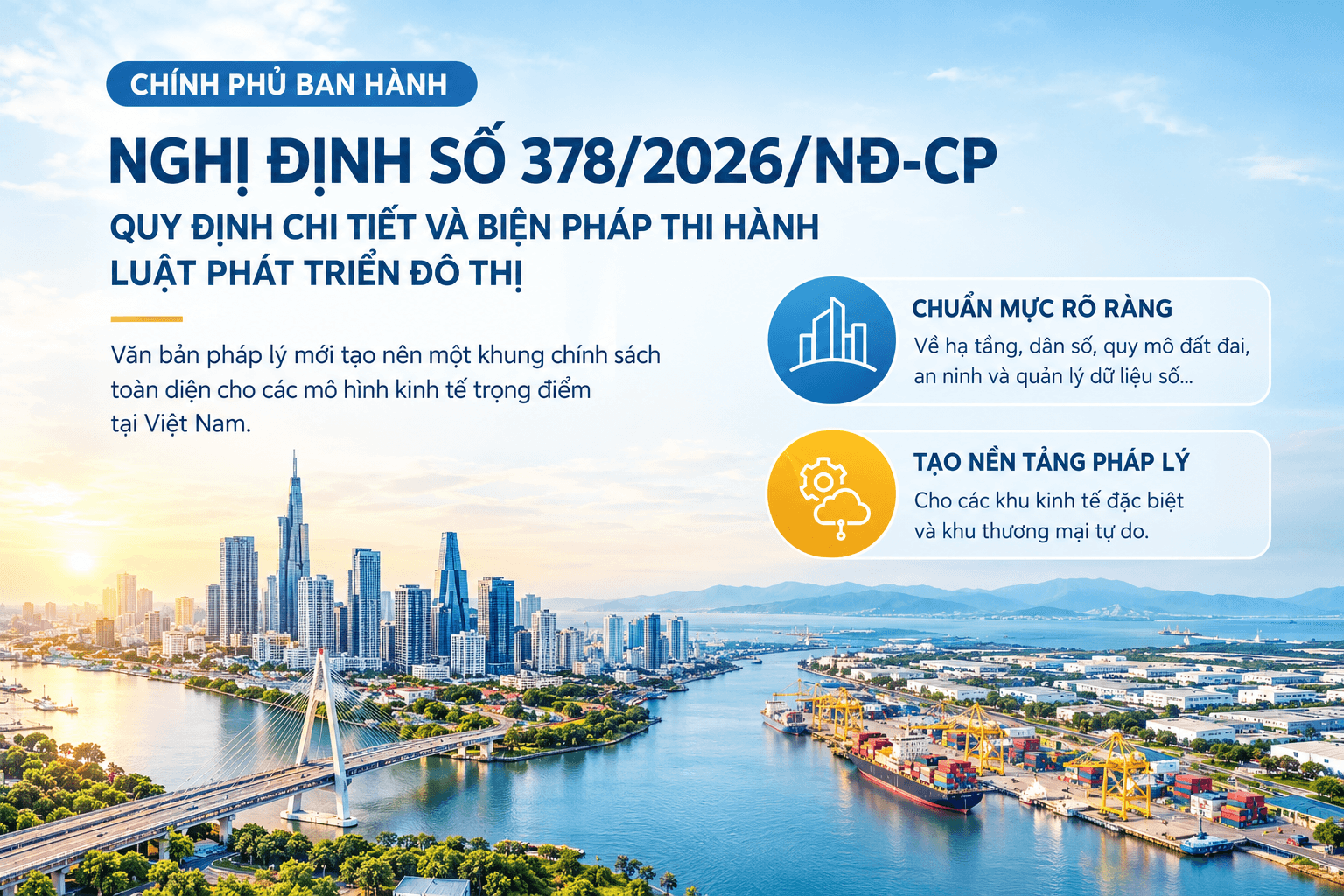

Investment Law No. 143/2025/QH15 was passed by the National Assembly on December 11, 2025 and takes effect on March 1, 2026, replacing the 2020 Investment Law. Provisions regarding the list of conditional business lines will apply from July 1, 2026. Below are the most notable points for foreign investors.
1. Business incorporation first, project registration later
Previously, foreign investors typically had to obtain an Investment Registration Certificate (IRC) for a specific project before incorporating a company (ERC). The new law reverses this sequence: investors can incorporate a business and receive the ERC first, provided they meet market access conditions. Consequently, the enterprise gains an early legal entity to lease offices, recruit personnel, negotiate contracts, and record pre-investment costs.
2. “Green lane” for projects in industrial parks
The law introduces special investment procedures for projects in industrial parks, export processing zones, high-tech zones, concentrated digital technology zones, free trade zones, international financial centers, and functional zones within economic zones. Eligible projects may be exempt from investment policy approval and enjoy reduced procedures such as technology appraisal, environmental impact assessment, planning approval, construction permits, and fire prevention – replaced by a commitment to meet standards and a post-audit mechanism. Certain large, important projects (such as airports and seaports) are not subject to this mechanism.
3. Narrowing cases requiring investment policy approval
Approval authority has been redistributed: the National Assembly approves only 1 group of projects, the Prime Minister 8 groups, and provincial-level People's Committee Chairpersons 13 groups. Two previously common cases – capital increases of 20% or more and technology changes – no longer require policy approval.
4. Reduction of conditional business lines
The law cuts about 38 business lines and narrows the scope of about 20 additional conditional business lines, while strongly shifting from “prior licensing” to “compliance and post-audit”.
5. Transitional provisions
- Projects that have been granted policy approval or certificates before the effective date of the law do not need to redo procedures.
- Dossiers submitted under the 2020 Investment Law will generally continue to be processed under the old law.
- New guiding decrees are being drafted – specific procedures and timelines require further monitoring.
What should enterprises do?
For investors preparing to enter Vietnam, the new law opens up two options worth considering: early incorporation of a legal entity for preparation, and prioritizing locations in industrial parks to take advantage of the “green lane”. However, market access conditions and post-audit requirements vary by sector, so careful review is necessary before deciding.
SUNINCON supports business incorporation, investment licences (IRC/ERC), work & residence permits, and tax and legal advisory, while connecting enterprises with suitable industrial parks. This article is for informational purposes and does not replace legal advice for specific cases.