
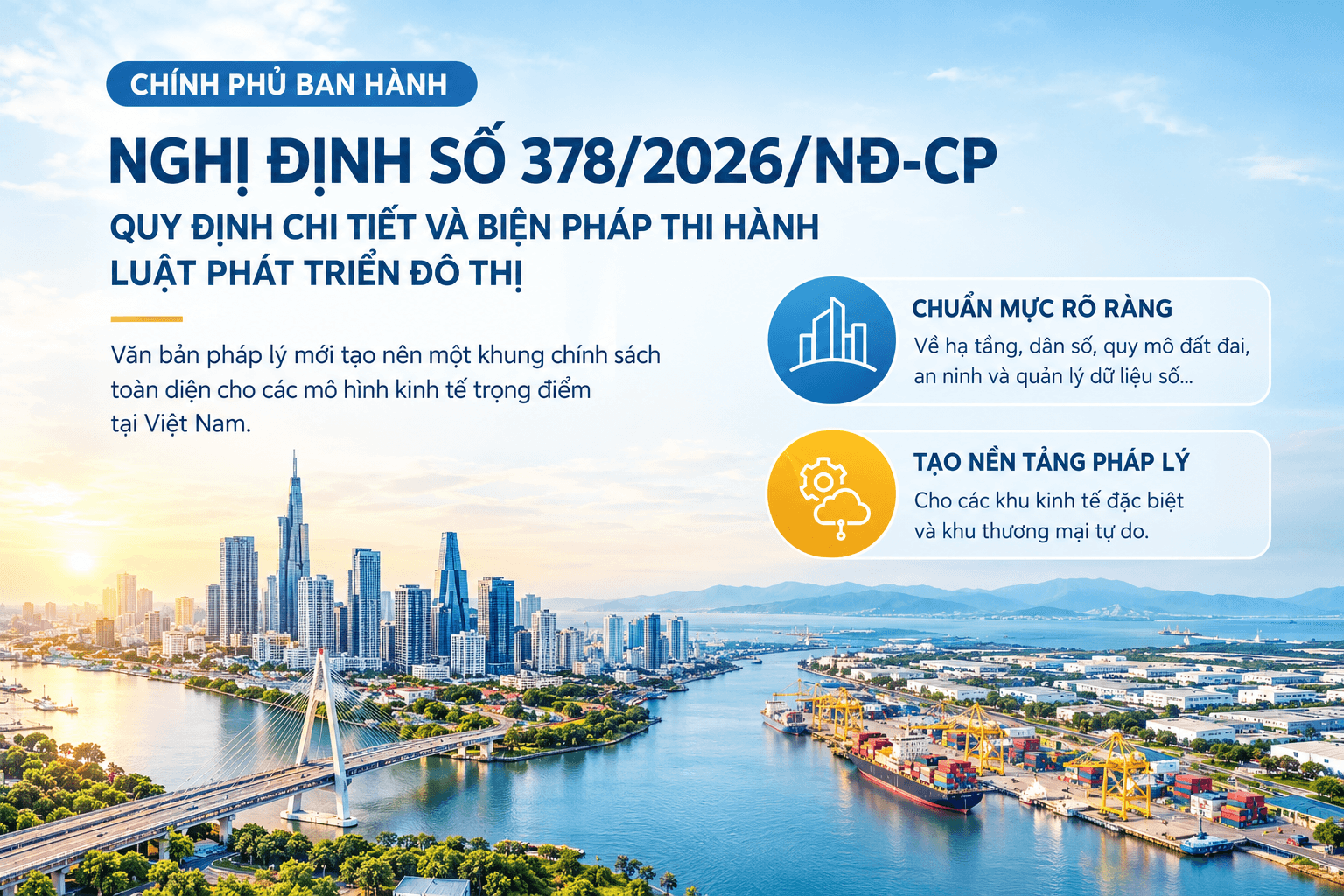
According to reports from VnEconomy, the Government has just issued Decree No. 378/2026/NĐ-CP detailing and providing measures for implementing the Law on Urban Development. This decree establishes a specific system of standards regarding infrastructure, population, land area scale, security, and digital data management for the development of special economic zones and free trade zones. The new legal document creates a comprehensive policy framework for key economic models in Vietnam.
Strict criteria framework for special economic zones
Pursuant to Decree No. 378/2026/NĐ-CP, a commune, ward, or special administrative unit may be considered for recognition as a special economic zone when it meets the standards stipulated in Article 43 of the Law on Urban Development. The mandatory requirements are allocated across three core content groups:
- Strategic location and planning linkage: The proposed area must have a location suitable for national socio-economic development orientations while making a practical contribution to national defense and security. This locality needs to be within the scope of a province or centrally-run city identified as a growth pole or national dynamic economic region; or as a regional growth pole, economic center, or key development region according to regional planning. In addition, provincial or municipal planning must also identify this place as a growth pole, the nucleus of a key economic region, an economic center, or a coastal economic zone, associated with safeguarding territorial sovereignty.
- International transport infrastructure: The area must have an international airport or a seaport classified as special or Type I seaport.
- Geographical space and development scale: The locality needs to have a relatively independent geographical space that is easy to manage, possessing a large population scale and land fund. Eligible areas include special administrative units, island communes, or places where at least 50% of the administrative boundary is coastline, or at least 50% of the natural boundary borders rivers, lakes, or protection forests. Regarding scale, the area must have a minimum population of 50.000 people and a natural area of 500 km2 or more.
Regulations on development and operation of free trade zones
Alongside special economic zones, Decree No. 378/2026/NĐ-CP also issues specific criteria and conditions for establishing free trade zones. The selected areas must possess a convenient geographical location to promote international trade, logistics, and related economic activities, while having a minimum area scale of 1.000 ha.
For cases where the free trade zone is arranged into multiple separate sub-zones that are not contiguous, regulations require ensuring synchronous infrastructure connectivity, alongside applying a unified management and operation mechanism.
In addition, the preparation of the project to establish a free trade zone must demonstrate socio-economic efficiency as well as land use efficiency. The decree emphasizes that the free trade zone must have close connection and mutual support with the system of existing economic zones, industrial parks, logistics centers, and neighboring functional areas, in order to ensure the ability to effectively integrate into the available industrial network.
In practice, the free trade zone model is attracting attention in many localities, typically represented by proposed orientations in Ho Chi Minh City, plans for establishment in Hai Phong, or the project associated with Gia Binh International Airport in Bac Ninh.
Significance for businesses
The legal framework from Decree No. 378/2026/NĐ-CP brings many valuable orientations for foreign investors considering establishing production bases and supply chains:
- Transparency in location selection criteria: Clear conditions on area scale (minimum 500 km2 for special economic zones and 1.000 ha for free trade zones) along with the requirement for the presence of an international airport or major seaport help businesses have a specific yardstick when evaluating long-term investment locations.
- Synchronization of logistics chain operations: The requirement for linkage between the free trade zone and existing industrial parks and logistics centers creates conditions for import-export businesses to optimize their transportation and raw material circulation networks.
- Staying ahead of key regions: The fact that localities such as Hai Phong, Ho Chi Minh City, and Bac Ninh are proactively implementing plans to establish free trade zones opens up early opportunities for investors to access land funds and infrastructure at major growth poles.
SUNINCON supports international investors through Market research, Industrial park surveys, and Supply chain advisory solutions, helping businesses accurately evaluate new development areas and build appropriate investment plans in Vietnam.