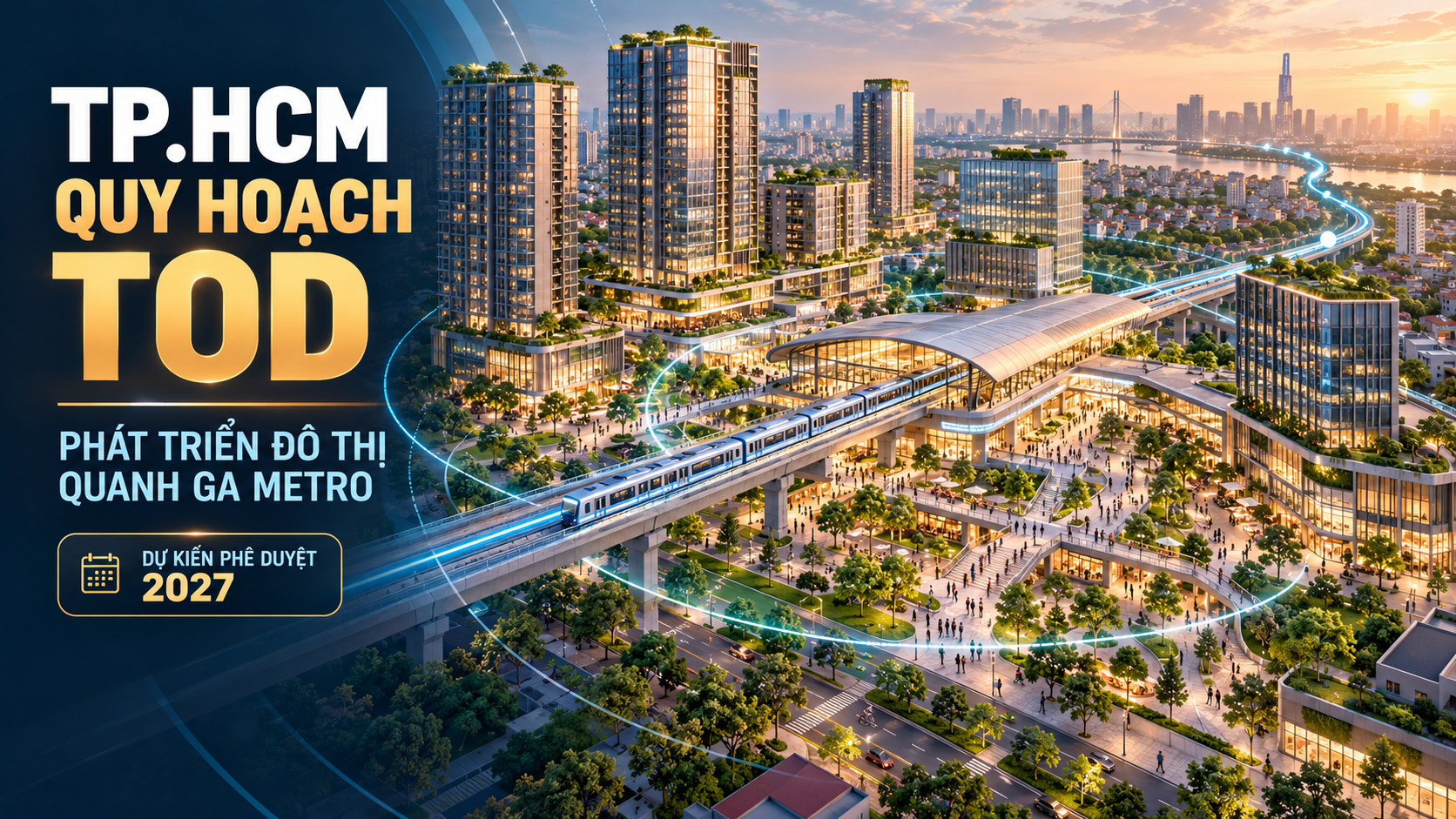
According to information recorded from VnEconomy, Ho Chi Minh City is actively implementing transit-oriented development (TOD) plans linked with multiple metro lines and key transport hubs. This orientation is expected to reshape urban space, create new growth poles, and attract strong attention from the international investment community.
Legal framework and implementation progress of TOD planning
According to the Ho Chi Minh City Department of Planning and Architecture, preparation work for the TOD model is being accelerated across multiple urban railway lines. Specifically, project dossiers for the Ben Thanh – Tham Luong section of Metro Line 2 are being finalized for submission, review, and planning approval in December 2026. Meanwhile, the Thu Thiem Station area has had its boundaries approved and is expected to complete approval procedures between December 2026 and January 2027.
In addition, areas such as Binh Khanh Station and the Tham Luong – Cu Chi section are expected to complete their boundary review reports in Q4 2026 before entering the official approval phase from Q1 to Q3 2027. For Metro Line 1 (Ben Thanh – Suoi Tien section), authorities are collecting opinions on boundaries for submission and approval in October 2026, with an official decision expected in the first half of 2027. The Ben Thanh – Can Gio high-speed railway line also follows a dossier completion schedule during this timeframe.
Spatial orientation and scale of new metro lines
Based on the City People's Council Resolution No. 21 on urban space and mixed-use functional clusters, areas surrounding stations will be planned as multi-functional spaces including housing, commerce, services, offices, and public amenities. Public transport plays a backbone role, combined with pedestrian systems and dedicated bicycle lanes.
According to reports from VnEconomy, the city also plans to commence construction on three new metro lines in Q4 2026, including Thu Dau Mot – Tao Dan, Tan Son Nhat – Phu Huu, and Binh Duong New City – Suoi Tien. Total preliminary investment for these three projects is estimated to exceed 254 trillion VND (equivalent to over 9.75 billion USD), with a total length of nearly 90 km, and completion expected by 2030.
Challenges in the implementation process
Alongside great potential, the city's Urban Railway Management Board pointed out three main groups of difficulties. First is schedule pressure as the city must complete eight priority lines and sections within the next four years. Second is the risk of delays from site clearance and land compensation work in crowded inner-city corridors. Third is the very large demand for public investment capital and funds from public-private partnership (PPP) formats, requiring an early finalization of the financial resource mobilization strategy.
Implications for businesses
The implementation of the TOD model and high-capacity transport lines brings broad cooperation opportunities for real estate developers, infrastructure contractors, and foreign planning experts. Areas surrounding stations open up potential to optimize exploitation values from land, underground space, and airspace according to green, energy-saving standards. Businesses need to closely monitor the planning approval timeframe of each line to prepare their capacity to participate in mixed-use and urban infrastructure projects.
SUNINCON accompanies foreign businesses through regional development survey services, connections with regulatory authorities, and in-depth market research.